
Content Strategy Template (2026 Edition)
I built this template to help India-focused teams turn ideas into steady results. I explain how I align content with business goals and audience needs so every task pushes brand awareness and measurable success.
This guide is practical and time‑wise: it shows steps, tools, and workflows you can use at once. I draw on 2025 trends — rising marketing investment, the power of short-form video, and the need for active online communities — to keep recommendations current and actionable.
I write in plain terms so teams can adopt a single source of truth without guesswork. Ready to see how a documented plan can save time, improve alignment, and speed up results across social, SEO, and governance?
Why Your Business in India Needs a Content Strategy in 2026
In 2026, Indian audiences spend more time on short-form feeds and expect active brand communities. I see brands win when they match formats to audience habits and measure what drives traffic and customers.
Short-form videos showed strong results for 17% of marketers in 2024. At the same time, 90% of social media marketers rate community building as essential. More than 90% of marketers kept or raised marketing budgets in 2025, so planning matters.
A documented content strategy aligns creators, social managers, and writers on shared goals like brand awareness and lead generation. It cuts duplication, clarifies priorities, and improves ROI by focusing resources on the formats that drive performance.
| Format | Business Benefit | Priority (India) |
|---|---|---|
| Short videos | Higher reach, better engagement | High |
| Community forums | Repeat customers, trust | High |
| Long-form articles | SEO traffic, authority | Medium |
With a clear plan, teams forecast resources, set quarterly goals, and keep measurement tight. That predictability turns effort into sustained awareness and measurable growth.
content strategy
I define a clear plan that links creative work to measurable business goals and audience needs. I mean the full cycle: planning, creation, publication, management, and governance so each asset has purpose.
I break the approach into repeatable parts. This makes it easier to scale across teams and cut rework. It also ensures legal, brand, and accessibility checks stay built in.
- Goals: set KPIs that map to awareness, leads, or sales.
- Audience insights: inform topics, format, and messaging.
- Audit & planning: find gaps, prioritize effort, and pick channels.
- Creation & distribution: assign roles and publish with intent.
- Measurement & governance: track results and enforce standards.
| Component | Purpose | Key output |
|---|---|---|
| Goals | Align with business priorities | KPIs and targets |
| Audience Research | Define needs and channels | Personas and topic list |
| Audit & Plan | Spot gaps and reuse opportunities | Roadmap and calendar |
| Governance | Maintain brand, legal, accessibility | Style guide and review flow |
I make a clear distinction: the calendar puts tasks into dates, while the higher-level plan drives what gets made and why. Good measurement prevents misalignment and keeps work focused on growth.
My 2026 Content Strategy Framework at a Glance
I lay out a simple loop that moves from SMART goals through measurement and back into better ideas. The aim is to make execution repeatable, reduce rework, and keep every page and channel consistent.
Below is the seven-step blueprint I use. Each step has clear checkpoints, tools, and owner roles so the team can act fast and stay aligned.
- Understand your audience — personas, pain points, and channels.
- Set SMART goals — map KPIs to awareness, leads, and revenue.
- Audit & analyze — find gaps, quality issues, and reuse opportunities.
- Plan & ideate — prioritize ideas with decision gates and briefs.
- Create & optimize — use templates, SEO checks, and quality reviews.
- Distribute & promote — pick paid, owned, and earned mixes for reach.
- Measure & iterate — dashboards feed back into new ideas and roadmaps.
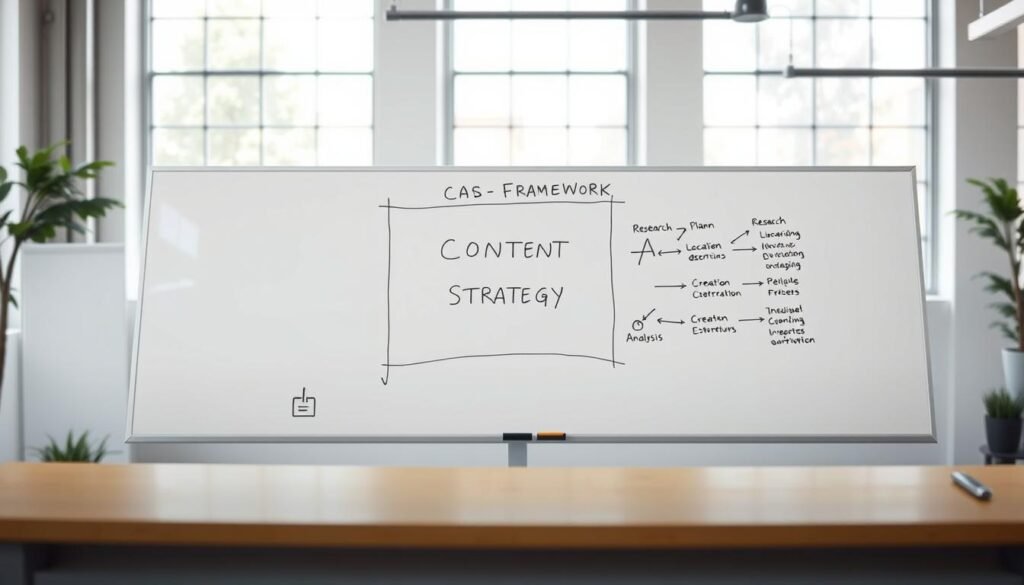
I include governance as a formal layer: roles, style guides, and workflows that protect compliance and brand voice. I also list tools and checkpoints for each step so handoffs stay clean.
| Step | Checkpoint | Tool / Artifact |
|---|---|---|
| Audit | Quality score, gap map | Audit report, spreadsheet |
| Plan | Decision gate, prioritization | Brief template, roadmap |
| Create | Review cycle, accessibility | Style guide, CMS page |
| Measure | Dashboards, learnings | Analytics, SOPs |
Define SMART Goals That Map to Brand Awareness, Leads, and Sales
I start by turning high-level business aims into SMART goals that teams can act on. Each goal has a clear KPI, a deadline, and a way to measure impact so nothing is vague.
Translating business objectives into measurable KPIs
I use the SMART framework to make objectives specific and measurable. For brand awareness I set reach and share-of-voice targets. For leads I track MQLs and pipeline movement.
- I set interim milestones so teams can course-correct before a quarter ends.
- I document assumptions: audience size, budget, and timelines to keep goals realistic.
- I align channel-level targets so each program contributes to the overall performance target.
Setting priorities with a north-star goal hierarchy
I organize goals by priority so urgent work wins limited resources. A north-star prevents competing goals and clarifies trade-offs.
| Goal Type | KPI Examples | Primary Metric | Review Cadence |
|---|---|---|---|
| Brand awareness | Reach, share of voice | Impressions & SOV | Monthly |
| Leads | MQLs, demo requests | Qualified leads | Weekly |
| Sales | Closed revenue, attribution | Revenue & conversion rate | Quarterly |
Know Your Target Audience: Personas, Pain Points, and Platforms
I map who I need to reach in India before I pick topics or channels. This keeps work focused on real needs, not guesses.
Collecting audience insights in India
I gather data from surveys, interviews, and social analytics to learn demographics, interests, and pain points. I add social listening with AI to capture large conversations.
CRM records unify touchpoints so I see behavior across sales and support. These information sources form testable hypotheses about my target audience.
Building buyer personas for B2B and B2C
I build personas with demographics, jobs, motivations, and barriers. I validate them with interviews and performance data.
- I segment by lifecycle stage so messaging fits awareness through decision.
- I use tools to merge qualitative and quantitative signals into usable audience stories.
- I create hypothesis-driven personas and update them from ongoing feedback.
Voice, culture, and language nuances
Regional voice and imagery shape tone and calls to action. I adapt messaging to local idioms and platform habits to improve relevance for customers.
| Element | B2B | B2C |
|---|---|---|
| Decision cycle | Long, committee-based | Short, individual choice |
| Persona elements | Role, KPIs, buying criteria | Demographics, aspirations, price sensitivity |
| Best platforms | LinkedIn, email, webinars | Instagram, short-video apps, Facebook |
| Key pain points | Integration, ROI, compliance | Trust, value, ease of use |
Run a Rigorous Content Audit to Find Gaps and Opportunities
A focused audit reveals which pages and posts drive real results and which need action.
I catalog titles, formats, word counts, topics, and KPIs for every URL. I use analytics to spot strengths and weak performance. Then I flag repurposing wins, like turning a top blog into short videos or a podcast episode.

Quality, relevance, and repurposing opportunities
I score quality and relevance against audience needs, not just vanity metrics. Scores feed a clear workflow: update, consolidate, or retire.
- I evaluate performance across pages, blogs, and posts using a standard sheet and tools.
- I collect URLs, metadata, topic tags, word counts, and KPIs for each asset.
- I map gaps by funnel stage and generate prioritized ideas for new assets.
- I mark repurpose options and assign quick wins to owners in the backlog.
- I recommend a quarterly mini-audit to keep the library fresh and aligned to the strategy.
| Activity | What to collect | Outcome |
|---|---|---|
| Inventory | URL, title, format | Complete audit list |
| Score | Metrics, relevance | Actionable rating |
| Action | Owner, task, deadline | Updated or retired page |
Choose Content Types and Channels That Fit Your Goals
I pick formats and channels that move readers through the funnel, from discovery to decision. I match choices to audience habits and business goals so each asset has a clear purpose.
I select content types like a blog, short videos, and audio episodes based on intent and effort. Pillar-cluster models help me build authority: a pillar page covers the core topic and clusters link related articles to improve discoverability.
- I map which channels suit each goal — owned (site, email), earned (PR, backlinks), and paid (social ads).
- I balance media to extend reach efficiently and compound returns over time.
- I adapt one idea across platforms with native variations to avoid duplication and boost engagement.
| Goal | Best types | Priority channels |
|---|---|---|
| Awareness | Short videos, blog summaries | Social ads, organic social |
| Consideration | Long-form guides, podcasts | Owned email, SEO |
| Conversion | Case studies, landing pages | Paid search, retargeting |
I tie every format and channel back to measurement. That way I test new platforms with clear criteria and scale what works for the Indian market as part of my ongoing marketing plan.
Social Media Content Strategy: Platform-by-Platform Game Plan
I map a platform-by-platform playbook so each social channel earns its role in your marketing mix.
Instagram, LinkedIn, TikTok, X, and Facebook: formats and frequency
I use clear posting cadences and native formats to lift reach and engagement. Short-form videos and Reels should be central where they perform best.
- Instagram: high-quality visuals, Reels, Stories — 1–2 posts daily.
- LinkedIn: professional posts, Live sessions — ~1/day.
- TikTok: short-form videos — 1–3/day focused on trends.
- X: real-time threads and Spaces — 3–5 posts/day.
- Facebook: community posts, videos, events — ~1/day.
Content pillars and balance rules
I use both the 70/20/10 and the 50/30/20 mixes to keep your calendar balanced.
| Rule | Mix | Purpose |
|---|---|---|
| 70/20/10 | 70% value, 20% curated, 10% promo | Build trust and avoid hard sells |
| 50/30/20 | 50% entertainment, 30% educational, 20% promo | Drive engagement and retention |
| Pillars | How-to, user stories, news | Anchor posts and videos across platforms |
When to prioritize community building
I favor replies, Q&As, and UGC spotlights when long-term trust matters. Put community before promotion in the early lifecycle and during product launches.
Build Topic Clusters and Pillar Pages to Win Search and Authority
I design topic clusters that guide users from discovery to decision via clear next steps. A strong pillar page sits at the center and links to supporting blog posts that answer niche queries.
Mapping search intent to clusters across the funnel
I map queries by intent: awareness, consideration, and decision. Each cluster includes overview copy on the pillar page and deeper posts for specific questions.
Internal linking that drives discoverability and conversions
Internal links connect broad and narrow pages so search engines see the topical map. I use descriptive anchor text that matches user intent and target keywords.
- I structure the pillar page with a clear table of contents linking to related posts and sections.
- I prioritize clusters where my site can earn authority fastest, based on gaps and competitors.
- I align CTAs to funnel stages: subscribe on awareness, demo on consideration, and trial on decision.
| Link Pattern | Purpose | Example Target |
|---|---|---|
| Hub → Spoke | Signal authority, improve crawl | Pillar page → blog posts |
| Spoke → Hub | Guide users to main page | Blog → pillar page |
| Cross-link | Keep users exploring | Related posts → posts |
I document metadata, headings, and schema to reinforce topical relationships. I track traffic and conversion lift from clusters and optimize continuously as new questions emerge.
Create a Content Calendar and Editorial Cadence That Scales
I set a clear cadence so themes guide work and daily schedules keep delivery predictable. Editorial calendars set the thematic direction and the content calendar schedules individual posts and send times. This two-layer approach keeps long-term ideas visible while the day-to-day plan handles execution.
Editorial themes vs. calendar details
I separate big themes from the daily calendar so planning is both strategic and tactical. Themes cover quarterly focus, campaigns, and product moments. The calendar lists dates, formats, assigned owners, and optimal time windows for each post.
Seasonality, campaigns, and cross-team collaboration
I layer seasonality and campaign peaks into the calendar so the team coordinates launches and support. Centralizing the plan lets marketing, product, and PR see dependencies and avoid last-minute conflicts.
Templates for ideation, briefs, and approval workflows
I use simple templates for ideas, briefs, and approvals to cut bottlenecks. Define SLAs for reviews, groom the backlog weekly, and align resource availability to avoid overcommitment. Schedule testing and repurposing slots so iteration doesn’t derail core commitments.
- Schedule posts at audience-active time windows using social tools and analytics.
- Centralize the calendar for cross-functional visibility and handoffs.
- Establish reporting touchpoints tied to the calendar to link activity with outcomes.
| Plan Layer | Purpose | Key Fields |
|---|---|---|
| Editorial calendar | Themes, campaigns, seasonality | Quarter, theme, owners |
| Content calendar | Daily posts, times, approvals | Date, format, SLA, publish time |
| Backlog | Groom ideas and prioritize | Idea, priority, ready date |
Production Process, Team Roles, and Brand Voice Consistency
I map clear handoffs from brief to publish to cut rework and speed delivery. Defining the end-to-end process keeps approvals fast and reduces mistakes.
From brief to publish: assigning responsibilities
I standardize briefs so each task carries goals, audience, angle, and distribution notes. That reduces back-and-forth and keeps the team focused on outcomes.
- I define editorial roles: writer, editor, designer, and approver with SLAs.
- I set review workflows in collaboration tools to protect quality without slowing velocity.
- I use checklists for accessibility, legal, SEO, and post-publication QA to catch issues fast.
| Role | Core responsibility | Tools |
|---|---|---|
| Writer | Drafts and follows brief | CMS, briefs |
| Editor | Edits, fact-checks, voice | Review board |
| Designer | Visuals and assets | Asset manager |
I codify voice guidelines so every page reads like a single brand. I plan resources and version control to keep handoffs clean. Finally, I track cycle time and quality gains to refine the process and improve output over time.
Influencers, Employee Advocacy, and Distribution Tactics That Amplify Reach
Leveraging creators and employee voices can plug distribution gaps and build trust fast. I treat creator partnerships as planned assets that slot into the editorial calendar so posts align with our pillars and campaign windows.

Integrating creator content into your calendar
I schedule creator deliverables alongside owned posts so launches feel coordinated, not scattered. Each brief names reuse rights, disclosure needs, and performance targets.
I repurpose short-form videos across channels to extend shelf life. This keeps customers seeing the same narrative in different places without repeating the same post.
Scheduling, optimal send times, and platform-native features
I use native scheduling and analytics to find send times that lift reach. Platform tools like hashtags, Groups, and Live broaden discoverability when used correctly.
- I formalize employee advocacy with a curated library and clear company guidelines.
- I plan community engagement around partner posts so momentum continues after a launch.
- I measure incremental reach, conversions, and attribution tied to creators and advocates.
| Tactic | Benefit | Key metric |
|---|---|---|
| Creator slot in calendar | Fills short-form video gaps | Incremental reach |
| Employee advocacy | Trust and social proof | Shares & referral traffic |
| Platform-native features | Improved discovery | Engagement rate |
Measure What Matters: KPIs, Dashboards, and Iteration Loops
I build dashboards that turn raw metrics into clear actions for the team. Measurement should link awareness and engagement with pipeline outcomes so every report answers one question: what do we do next?
Brand awareness: reach, impressions, share of voice
Track impressions and reach to judge visibility across platforms. Measure share of voice to see how you compare with peers in India and identify gaps in marketing presence.
Engagement: comments, shares, saves, view time
Monitor comments, shares, saves, and average watch time to spot formats that hold attention. These signals tell you which formats to scale or adapt for better traffic and leads.
Business impact: CTR, conversions, revenue attribution
Connect CTR and conversion rates to attributed revenue so marketing shows real business impact. Use cohort tracking and monthly analysis to validate what improves sales and repeat visits.
- I define tiered KPIs—awareness, engagement, and business impact—mapped to your goals.
- I set up dashboards that show traffic, CTR, conversions, and revenue in one place and automate recurring reports.
- I run monthly reviews, A/B tests on headlines and CTAs, and keep an experimentation backlog ranked by expected lift and effort.
- I close the loop by feeding learnings back into briefs, calendars, and creative direction so iterations become faster and smarter.
| Tier | Key metrics | Action |
|---|---|---|
| Awareness | Reach, impressions, share of voice | Increase distribution or partner slots |
| Engagement | Comments, shares, saves, watch time | Optimize format, headline, and placement |
| Business impact | Traffic, CTR, conversions, attributed revenue | Adjust funnel, test CTAs, reallocate spend |
Governance, Compliance, and Content Quality Standards
Clear rules for tone, approvals, and accessibility keep every page reliable and on-brand. I set formal governance so the team knows who approves what, when, and how to fix issues fast.
Style guides, tone, accessibility, and review cycles
I codify voice rules, style guides, and accessibility checks the team can apply daily. That reduces rework and keeps the brand consistent across pages and partners.
- I define review cycles and approver roles to keep quality high without blocking progress.
- I create legal and regulatory checklists tailored to our company and market in India.
- I maintain a quality bar for every page and asset so output is consistent and auditable.
- I allocate resources to training and enablement so teams use the rules with confidence.
- I document exceptions and escalation paths so edge cases get fast resolution.
| Governance Area | Purpose | Success Metric |
|---|---|---|
| Style & voice | Consistent brand tone | Cross-channel reviews passed |
| Accessibility | Inclusive pages and assets | WCAG audit score |
| Review cycles | Fast, clear approvals | Cycle time & rework rate |
I tie governance to measurable success: lower error rates, shorter cycle time, and fewer revisions. I integrate rules into tools so adherence is trackable and part of daily workflows.
2026 Trends: AI, Voice Search, and Personalization in India
Generative AI and voice assistants are reshaping how Indian brands reach real customers. I focus on practical uses that save time and lift relevance while keeping accuracy and brand guardrails in place.
Generative AI for ideation, optimization, and analysis
I use generative AI to speed ideation, run rapid SEO checks, and summarize analytics. This frees me from repetitive tasks so I can test higher‑impact experiments.
I set review rules: human edit, factual checks, and bias scans before any asset goes live.

Designing for voice and conversational journeys
Voice search needs natural answers and shorter phrases that match assistant queries. I design pages and scripts to answer spoken questions and win feature snippets.
Dynamic personalization and improved segmentation
Real‑time rules let me show different messaging to audiences based on behavior and location. Personalized recommendations lift conversions and long‑term retention.
- I test short videos and UGC on social media to boost awareness and trust, inspired by Indian campaigns like Swiggy’s community-driven work.
- I pilot tools for media planning, creative iteration, and measurement with clear KPIs and rollback plans.
| Use | Example tool | Metric |
|---|---|---|
| Ideation & drafts | Generative models | Time saved |
| Voice testing | Query simulators | Snippet wins |
| Personalization | Realtime segmentation | CTR lift |
Conclusion
I close with a short plan you can use this quarter to turn the seven-step framework into measurable gains. I recap how audience work, goals, audits, calendars, and measurement join to deliver steady results.
A documented content strategy aligns teams, reduces wasted effort, and raises visibility and trust for your business. One example from the guide shows how a pillar page plus cluster posts lifted organic traffic in six weeks when paired with social reels.
Finalize your goals, audit your library, and stand up a 90-day plan. Share the plan with stakeholders and schedule monthly reviews so learnings feed into next steps.
Consistent execution beats sporadic effort. Start now, measure often, and refine as you go for lasting success.